The pardon process in Pennsylvania follows statewide procedures. LASP is not currently representing pardon applicants.
This page provides a self-help guide to help you navigate the process.
You may want to consider applying for a pardon if:
You plan to work outside of Pennsylvania, or
Have major convictions that are ineligible for other types of record-clearing.
Important note about the pardon process:
View or download LASP’s self-help guide here: LASP Pro Se Pardon Guide 2026
Visit the Pennsylvania Board of Pardons website: https://www.pa.gov/agencies/bop
What is a Pardon?
A pardon is an act by the governor of Pennsylvania that allows a conviction to be erased from your criminal record.
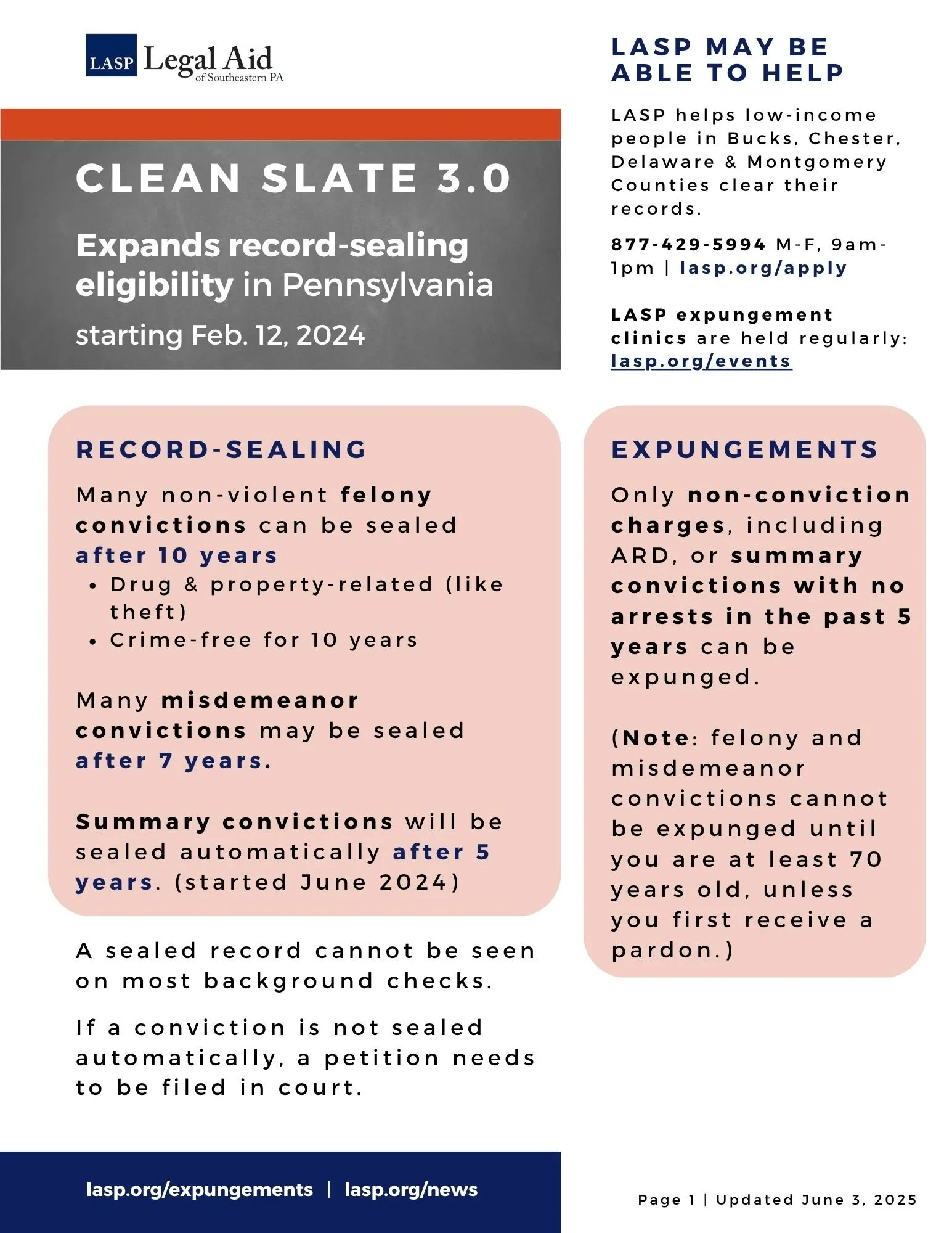
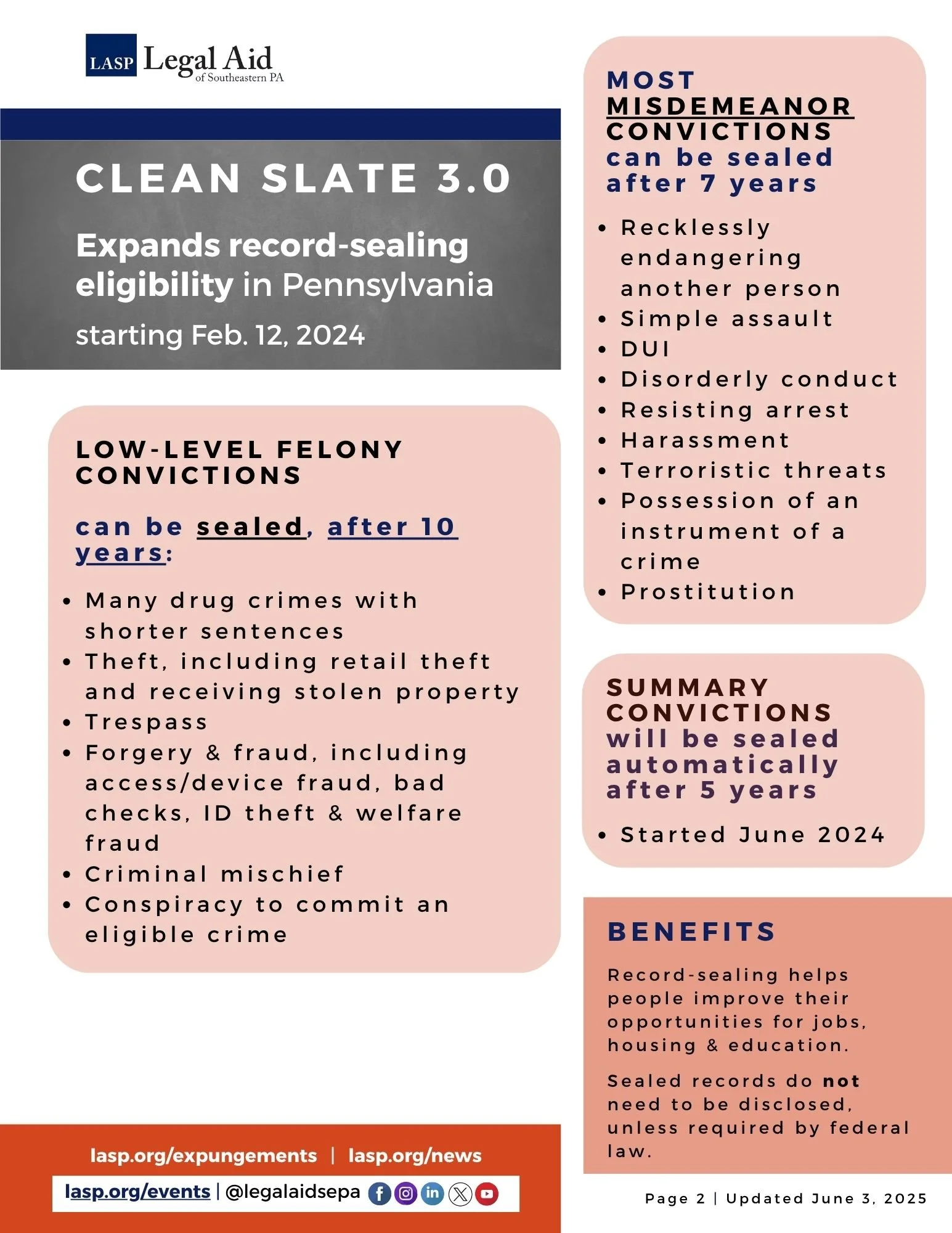
In Pennsylvania, a pardon is generally the only way that felony and misdemeanor convictions can be expunged before you reach the age of 70. Many lower-tier felonies and misdemeanors may be eligible for sealing, which shields your record from public view. Learn more about limited access (record-sealing, or Clean Slate, in this section.
Although it is difficult to get a pardon, you should consider applying for one if you are experiencing problems with employment, housing, education, etc. because of your criminal record. The process from application to hearing is currently estimated to take around 10 years. It is free to apply for a pardon, but there may be some costs associated with obtaining a background check and required court documents.
If you are granted a pardon, your criminal record will be automatically expunged.
Who can get a pardon?
If you have a criminal record, you may apply for a pardon. There are no defined standards for when a pardon will be granted, but most people who receive a pardon have a criminal history of misdemeanor offense that was committed at least five years ago, or a felony offense that was committed at least ten years ago. Typically, more serious crimes are only pardoned if several decades have passed since the crime was committed.
The longer you have gone without any arrests, charges, or convictions, the better your chances of getting a pardon.
How do I apply for a pardon?
Step 1: Begin by downloading the application.
You can also apply online, but there is no way to save your progress along the way. If you apply online, you should wait until you have fully completed preparing your application materials.
Step 2: Collect the required documents.
As detailed in the application instructions, there are some documents that you must obtain prior to submitting an application.
Background Check
LASP highly recommends starting with an Access and Review background check from the PA State Police. You can download the form on the PA State Police website:
Court Records
Once you have your background check, you need to request the following documents from the Clerk of Courts in the County that you were convicted in:
NOTE: If the Clerk of Courts cannot find any of these documents, ask for a letter explaining why this information cannot be provided.
STEP 3: Draft your statements.
Incident Statements
For each one of the cases on your record, the Board of Pardons asks for a brief explanation of what happened. They are looking for context to your conviction. What were the circumstances in your life at the time? Were you the main perpetrator or an accomplice? Remember: the Board wants to see accountability! Take responsibility for the crime.
Personal Statement
Although the personal statement is technically optional, LASP strongly recommends that you submit a thoughtful statement to the Board. This is your opportunity to show the Board how much you have changed since the time of your conviction.
STEP 4: Obtain letters of support from your community.
The Board likes to see that your community stands behind you in the pardon application process. LASP recommends getting at least three letters of support, but the more, the better!
You can provide this 1-page handout to friends, family, community leaders, etc. that provides further instructions for drafting a letter of support to the Board. (Note: The 1-page handout is also part of LASP’s 12-page Pardon Guide.)
You can attach other documents to your application as well! If you have earned a GED, high school diploma, or college degree, add a copy to your application. Include job training certificates, awards, honors, community service recognition, etc. Present all your achievements and anything you are proud of!
STEP 5: Submit your application.
Once you have everything together, it’s time to submit your application. You should triple-check your work, and leave nothing blank! If a section doesn’t apply to you, write “N/A.” If it is left blank, the Board will mark it incomplete and ask you to re-submit. This only delays the process further.
After you submit your application, you will receive communication from the Board of Pardons indicating that they have received it. They will assign you an application number—you should cite this number any time you communicate with them.
What happens next?
Wait a very long time.
Parole Interview.
Merit Review.
Public Hearing.
Results.
If you are granted a pardon, congratulations!
If you are denied a pardon, you can apply for reconsideration, or you can submit a new application after one year.
A note on Expedited Review
An expedited review of your application cannot be requested. The Board of Pardons screens all applications to determine whether you qualify for a “fast-tracked” application. The Board bases this decision on the types of offenses on your record and the number of years that have elapsed since your last conviction. More information about the automatic review process can be found here: https://www.pa.gov/agencies/bop/about-the-clemency-process/expedited-clemency-review.
More information about the pardon process is located at the Board of Pardons website, at www.bop.pa.gov/